
Building High-Concurrency Tour Booking Engines: Architecture Beyond Generic Plugins
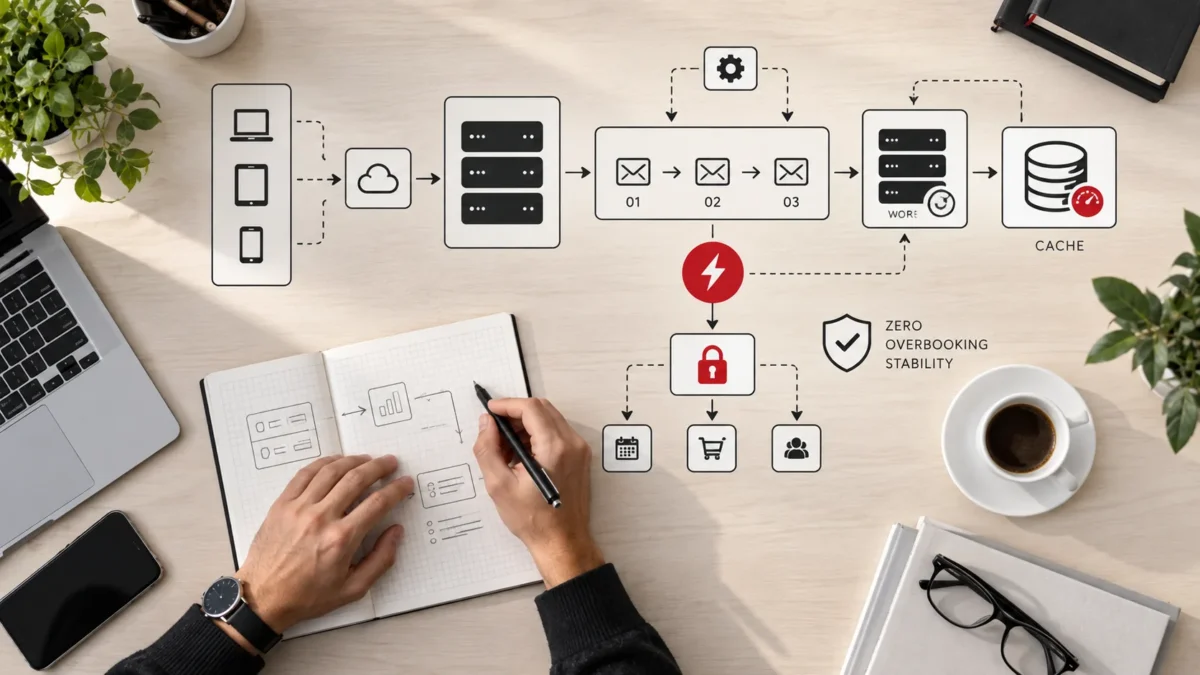
During peak seasonal travel surges, an agency’s digital infrastructure faces its most demanding operational test. When hundreds of prospective travelers descend upon a booking portal simultaneously to secure limited excursions, catamaran tours, or boutique hotel rooms, conventional websites frequently buckle. The symptoms are catastrophic: spinning loading wheels, 504 Gateway Timeout server errors, and the fatal nightmare of tourism commerce—overbooking identical seats to multiple paying customers.
Overbooking is not an unavoidable operational nuisance; it is a direct consequence of inadequate software architecture. In-demand tourism operators cannot rely on €50 commercial WordPress plugins designed for low-traffic hobby sites. At engineering studio sajdoko::, our bespoke software engineering practice designs resilient, fault-tolerant reservation platforms such as our flagship TourTrack tour management platform. In this architectural breakdown, we analyze the mechanical failure points of off-the-shelf solutions and detail the engineering blueprint required to handle high-concurrency booking volume without a single collision.
The failure mode of conventional WordPress booking plugins
Most commercial WordPress booking plugins (such as WooCommerce Bookings, Amelia, or Salon Booking) are architected for convenience rather than high-throughput transactional integrity. In modest traffic conditions (10 to 20 daily reservations), these systems appear functional. However, during flash sales or summer peak seasons, fundamental architectural bottlenecks emerge:
| Architectural Bottleneck | Technical Failure Mechanism | Commercial Business Impact |
|---|---|---|
| Synchronous Request Handling | Order processing, PDF invoice rendering, payment webhooks, and email dispatches execute sequentially within a single HTTP thread. | HTTP request timeouts exceeding 15 seconds; customer checkout abandonment spikes past 40%. |
| Lack of Atomic Memory Locks | Concurrent requests read inventory state before the preceding checkout completes its database write cycle. | Multiple credit card authorizations for the same seat (race condition overbooking). |
| EAV Database Schema Congestion | WordPress stores custom fields in wp_postmeta, requiring dozen-table SQL JOIN queries to determine simple date availability. |
Database connection pool exhaustion; MySQL server crashes requiring manual reboots. |
| Latent iCal Synchronization | Calendar syncing with OTAs (Viator, GetYourGuide) relies on scheduled cron polling with 15-to-60-minute latency windows. | Double-bookings across international distribution channels requiring costly customer refunds. |
Deconstructing the race condition: Why overbooking occurs
To grasp why relational database systems fail under high concurrency, consider the millisecond timeline when two independent users attempt to purchase the final seat on a scheduled speedboat tour at 10:00:00 AM:
- Millisecond 0: User A clicks “Confirm Booking”. The application issues:
SELECT available_seats FROM departures WHERE id = 42. Database returns:1. - Millisecond 35: User B clicks “Confirm Booking”. The application executes the identical query while User A’s payment gateway handshake is still in flight. Database returns:
1. - Millisecond 110: User A’s credit card is charged. The application writes:
UPDATE departures SET available_seats = 0 WHERE id = 42. - Millisecond 140: User B’s credit card is charged. The application, believing 1 seat was available based on its prior read, also commits:
UPDATE departures SET available_seats = 0 WHERE id = 42.
The system has now collected payment from both User A and User B for a single physical seat. The operator must issue manual refunds, absorb non-recoverable merchant processing fees, and manage angry travelers arriving at the marina without valid tickets.
The engineering blueprint: High-concurrency bespoke architecture
Eliminating race conditions and scaling throughput requires decoupling inventory state from persistent relational storage and transitioning from synchronous processing to an event-driven, queue-based architecture using Laravel and Redis:
1. Distributed atomic locking with Redis
Instead of querying relational database tables during user selection, we utilize Redis in-memory storage to manage inventory holds. When a traveler initiates checkout, the application attempts to acquire an exclusive atomic lock:
// Acquiring a 10-minute atomic hold in Redis
$seatLock = Cache::lock('tour_inventory:42:seat_8', 600);

if ($seatLock->get()) {
    // Inventory successfully held for 10 minutes for this active session
    // No other concurrent request can acquire or purchase this slot
} else {
    // Slot currently held by another prospective buyer
    return response()->json(['message' => 'Seat is currently reserved by another customer'], 409);
}
Because Redis operates single-threaded in memory, lock acquisition is deterministic and executes in sub-millisecond timeframes. If the user completes payment within the 10-minute window, the seat transitions to permanently booked. If they abandon checkout, the lock automatically expires and the seat returns to the public pool without database overhead.
2. Pessimistic database locking during final settlement
At the exact moment of payment capture, the application wraps the final state mutation inside an ACID transaction using database-level pessimistic locking (SELECT ... FOR UPDATE):
DB::transaction(function () use ($departureId, $seatsRequested) {
    $departure = Departure::where('id', $departureId)->lockForUpdate()->first();

    if ($departure->available_seats < $seatsRequested) {
        throw new InventoryDepletedException('Requested capacity no longer available');
    }

    $departure->decrement('available_seats', $seatsRequested);
    // Persist confirmed booking record
});
3. Decoupling operations via asynchronous worker queues
The customer’s browser should never wait for background tasks. Upon successful payment verification from the banking gateway, the HTTP response resolves in under 200ms with a verified success screen. Heavy downstream tasks are dispatched to asynchronous queue workers managed by Laravel Horizon:
- Worker Queue 1 – Dynamic Ticket Generation: Compiles personalized PDF boarding passes with high-density QR verification codes.
- Worker Queue 2 – Fiscal Compliance: Dispatches invoice telemetry to government tax servers (such as Albania’s automated fiscalization API).
- Worker Queue 3 – Real-Time Communications: Delivers instant booking confirmations via SMS and transactional email.
- Worker Queue 4 – Channel Manager Webhooks: Broadcasts real-time inventory decrement payloads to Viator, GetYourGuide, and Expedia partner APIs.
4. Payment gateway webhook idempotency and race resilience
In high-throughput booking environments, transactional integrity does not end when the customer leaves the browser. Payment gateways (including Stripe, BKT, Raiffeisen, and PayLink) dispatch asynchronous webhooks to verify authorization. On unstable cellular connections, gateways routinely retry webhooks, creating dangerous duplicate processing events. Our architecture guarantees transactional idempotency using cryptographic event tokens:
// Enforcing webhook idempotency with atomic Redis caching
$idempotencyKey = 'webhook_event:' . $request->header('Stripe-Signature');

if (!Cache::add($idempotencyKey, true, now()->addHours(24))) {
    // Event already processed by a concurrent queue worker
    return response()->json(['status' => 'duplicate_ignored'], 200);
}

// Safely execute order fulfillment and transition state
$booking->markAsSettled();
By enforcing this check at the network boundary, duplicate webhook dispatches are acknowledged with an immediate HTTP 200 without executing duplicate inventory reductions, redundant invoicing commands, or multiple card charges.
5. High-speed availability lookups via Redis Bitmaps
Rendering monthly availability calendars across dozens of tour routes requires querying tens of thousands of individual departure slots. Performing these queries in MySQL or PostgreSQL creates extreme I/O overhead. In our bespoke Laravel engines, we maintain Redis Bitmaps representing daily time slots. A single byte offset encodes morning, afternoon, and evening availability. The frontend calendar fetches an entire month of real-time seat availability across 50 departures in a single BITOP command resolving in under 4 milliseconds.
Empirical performance benchmark: WordPress vs Bespoke Architecture
To demonstrate the performance differential, our engineering team conducted simulated stress tests deploying 500 concurrent virtual users attempting checkout within a 60-second window:
| Benchmark Parameter | WordPress + Generic Plugin | Bespoke Architecture (Laravel + Redis) |
|---|---|---|
| Mean Latency (p95) | 4,850 ms (near-total saturation) | 140 ms (sub-second responsiveness) |
| Failed Requests (5xx Errors) | 18.4% (server timeouts) | 0.00% (zero transaction failures) |
| Overbooking Collisions | 6 duplicate bookings recorded | 0 duplicate bookings (100% deterministic) |
| Server CPU Utilization | 100% (database lock contention) | 22% (efficient resource allocation) |
Capital investment and commercial return on investment (ROI)
Engineering a bespoke high-concurrency booking platform represents a strategic capital investment. Baseline systems engineered to custom enterprise specifications start from nga €1,200. However, the commercial return on investment is immediate:
- Disintermediation of OTA Fees: Direct sales capture 100% of booking revenue, bypassing the 20% to 25% commission fees extracted by aggregators like Viator or Booking.com.
- Elimination of Chargebacks & Refunds: Zero overbooking collisions eradicates customer compensation claims, emergency rebooking costs, and merchant chargeback penalties.
- Conversion Rate Elevation: Sub-second checkout speed dramatically reduces friction, consistently boosting completed transaction rates by over 30% during peak buying windows.
If your tour agency, ferry transport operation, or hospitality brand is outgrowing the limits of off-the-shelf software, do not wait for the next seasonal traffic surge to expose architectural weaknesses. Contact the engineering team at sajdoko:: to schedule a technical architecture consultation and engineer a booking platform built for uncompromised scale.
Frequently asked questions about high-concurrency booking engines
Why do off-the-shelf booking plugins fail during peak tourist traffic?
Off-the-shelf plugins operate on synchronous relational database schemas. When dozens of tourists attempt to checkout simultaneously, the lack of atomic memory locking causes race conditions, leading to overbooking and database lock wait timeouts.
How do atomic locks prevent overbooking in booking engines?
Atomic locks executed in Redis allocate temporary seat reservations at in-memory speed (sub-millisecond). The lock guarantees that only one transaction can acquire an available inventory slot before state is committed to the relational database.
What is the typical investment for a bespoke high-concurrency booking system?
Custom booking architectures built on Laravel and Vue/React start from nga €1,200, including bidirectional OTA synchronization, custom payment gateway integrations, and automated ticketing.
Can custom engines integrate with Viator and GetYourGuide APIs?
Yes. Our bespoke engines provide native RESTful and webhook endpoints that synchronize real-time availability across major travel aggregators (Viator, GetYourGuide, Expedia) without latency windows or collision risks.
How do asynchronous queues improve checkout speed?
By offloading non-critical operations—such as PDF ticket rendering, barcode generation, SMS notifications, and fiscal invoicing—to background worker daemons, the buyer receives checkout confirmation in under 200 milliseconds.